- No products in the cart.
10% of profits donated to men’s mental health initiatives
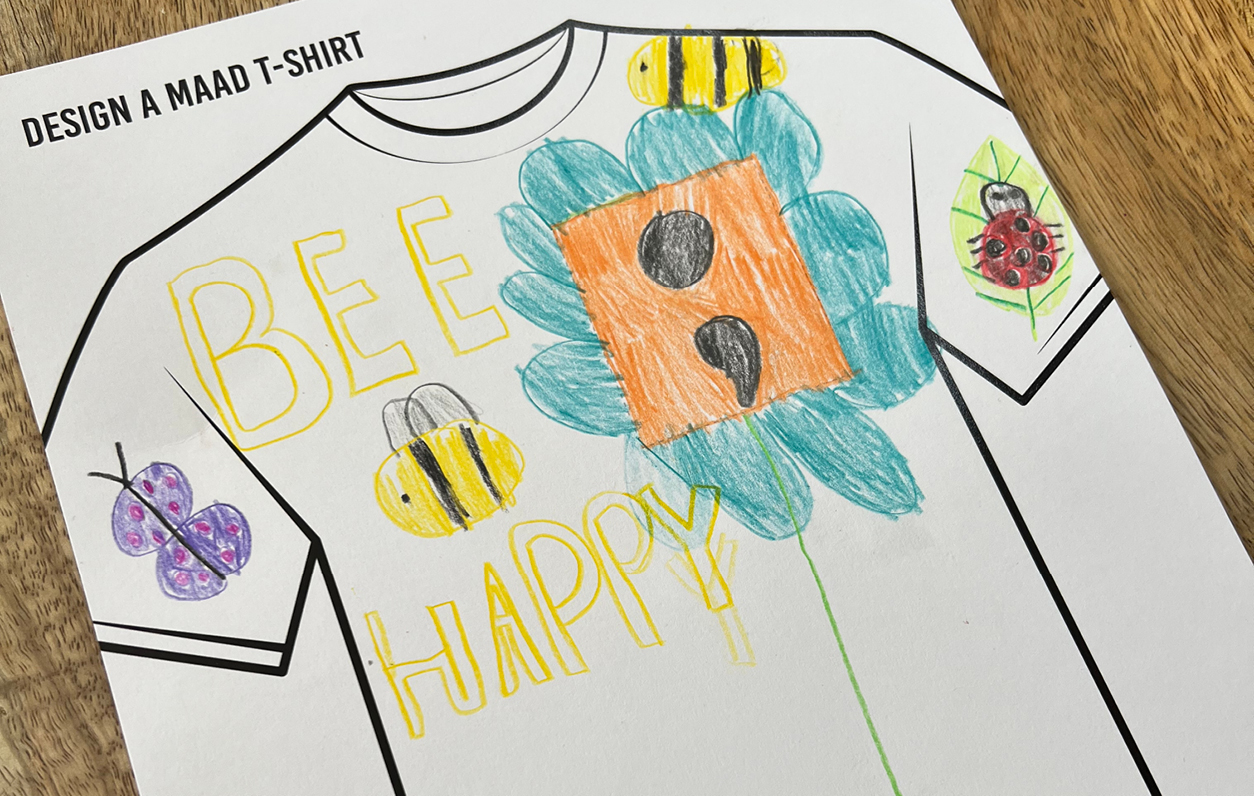
A little while ago, we had some worksheets printed for an upcoming MAAD project with Quince Counselling.
We’re inviting children from local schools to create their own T-shirt designs around mental health, happiness and wellbeing, with one eventually being chosen to become a limited-edition MAAD T-shirt. One of those worksheets was lying around at home when my eight-year-old daughter picked it up and decided to have a go herself. Her idea was incredibly simple, she drew a bee and wrote two words:
BEE HAPPY.
That was it. But the more I looked at it, the more I liked it, there was no complicated message behind it, no attempt to explain happiness or mental health. Just an eight-year-old’s response to the question in front of her.
Bee happy. And it got me thinking about something. When did happiness become so complicated?
Ask a child what makes them happy and the answers are often wonderfully uncomplicated. Playing football, seeing their friends, drawing a picture, going to the park, having their favourite dinner, making somebody laugh and spending time with the people they love.
Then somewhere between childhood and adulthood, things seem to get considerably more complicated. Happiness can start to become attached to achievement, the job, the house, money, success, how we look, what we own, where we go and whether we’re keeping up with everybody else.
We tell ourselves we’ll be happier when we earn a little more, achieve the next thing, finish the next project or finally get our lives into whatever shape we think they’re supposed to be in. And increasingly, we have a window into everybody else’s life while we’re doing it. We see the holidays, promotions, new houses, perfect families, fitness transformations and achievements. We rarely see the arguments, worries, insecurities, sleepless nights or completely ordinary Tuesdays happening around them.
Without necessarily realising it, we can start measuring our own lives against everybody else’s highlights.
Happiness becomes something to achieve rather than something to notice.
I’m not suggesting children don’t struggle. They absolutely do, and supporting young people’s mental health is incredibly important. Nor do I think the answer to anxiety, depression or any other mental health struggle is simply to “be happy.” If only it were that straightforward. But I do think there’s something interesting about the way children can experience moments without constantly asking what those moments mean for everything else.
They can be completely devastated because their ice cream fell on the floor and ten minutes later be running around laughing again. They can spend an hour kicking a football around without wondering whether they were productive enough that day and they can create something simply because creating it is fun, without wondering what anybody else is going to think of it.
Maybe growing up inevitably takes some of that away from us. We gain responsibilities, we experience loss, relationships become more complicated, there are mortgages, careers, bills, expectations and people relying on us.
Life genuinely does become more complicated, but perhaps that makes remembering the simple things even more important.
The worksheet my daughter picked up was actually created for a much bigger project we’re about to begin with Quince Counselling. Hundreds of children will be given the same opportunity: to create something around mental health, happiness and wellbeing, with one of those designs eventually becoming a limited-edition MAAD T-shirt.
And after seeing BEE HAPPY, I’m even more interested to see what everyone else creates.
Not simply because we’re looking for a great T-shirt design, but because every one of those drawings will tell us something about how a child sees the world. What makes them happy? What matters to them? What does feeling good look like? What would they want somebody else to see or hear?
The finished T-shirt will be exciting. But the conversations around those hundreds of pieces of paper could be far more important.
If a child goes home and tells their parents what they’ve drawn and why, that’s a conversation. If a classroom talks about what makes them happy, that’s a conversation. If somebody thinks about what they could do when they’re having a difficult day, or how they might help a friend who’s struggling, that’s a conversation too.
And if talking about feelings, happiness and mental health becomes a little more normal when you’re eight, nine or ten years old, perhaps those conversations become a little easier when you’re eighteen, twenty-eight or forty-eight too.
That’s something worth encouraging.
When we started putting this project together, I naturally thought about what we could give to the children involved. An opportunity to be creative, a reason to think about mental health or a chance to start conversations that might not otherwise happen.
But after seeing the first design, I’ve started wondering whether we’ve got that slightly backwards, maybe they’ll give something even more valuable back to us. Hundreds of children are going to respond to the same idea without decades of adult experience shaping their answers.
I’m genuinely curious to see what they tell us. What matters to them? What makes them feel good? What do they think somebody needs when they’re having a difficult day? What does happiness actually look like through their eyes?
Maybe their answers will be complicated, but I suspect quite a few won’t be.
My daughter didn’t intend any of this when she picked up that worksheet. She drew a bee, she wrote BEE HAPPY and then she carried on being eight.
Perhaps that’s why I’ve thought about it so much. Life isn’t always easy, happiness isn’t permanent, nobody walks around feeling good every minute of every day, and pretending otherwise doesn’t help anyone.
But maybe happiness doesn’t always have to be something enormous waiting for us somewhere in the future. Sometimes it’s kicking a football around with your kids, a conversation with somebody you care about, a coffee in peace, a song you’ve heard a hundred times or laughing at something completely stupid.
Maybe growing up isn’t about finding a way back to the uncomplicated happiness we had as children, maybe it’s just about learning to recognise those little moments again when they appear. Because perhaps happiness was never quite as complicated as we made it.
Sometimes we just forget to notice it.
BEE HAPPY. 🐝